Best Wireless Cat Water Fountain UK: Choose for the Cat, Not the Feature List
Choose a wireless cat water fountain by drinking preference, cleaning access, backup water, battery routine, noise and return terms, with a cautious UK introduction plan.
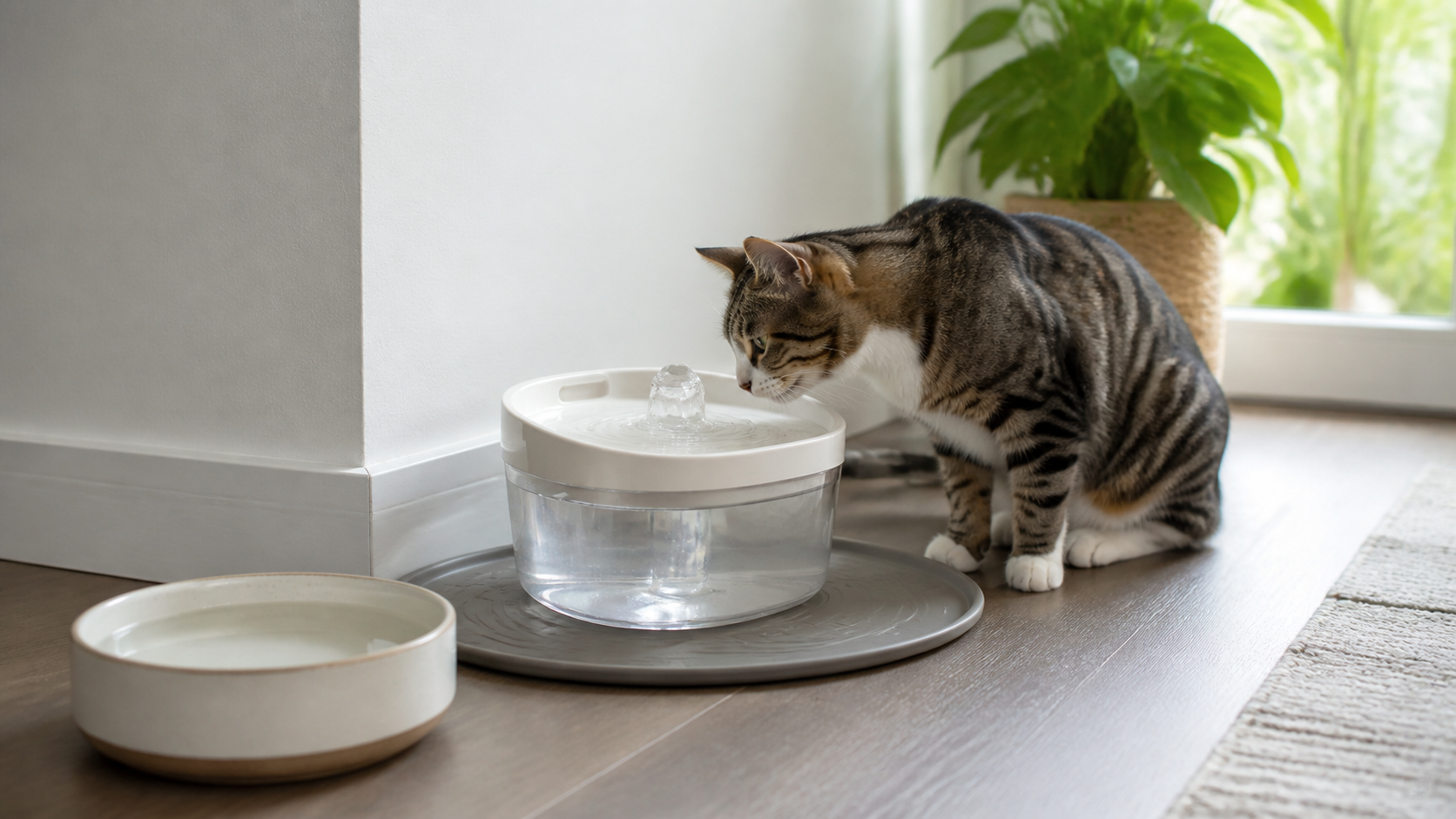
The best wireless cat water fountain is not automatically the one with the biggest tank, longest feature list or loudest health promise. It is the fountain your cat will use, that you can dismantle and clean properly, and that continues to leave the cat with fresh water when the battery is flat or the pump is being washed.
Cordless placement can be genuinely useful in a UK flat or a home with awkward sockets. It lets you put water away from food and litter, which Cats Protection recommends, and removes a trailing power lead from the drinking area. The trade-off is a new maintenance job: somebody must monitor the water, pump, filter and charge state.
The short answer
Choose in this order:
- your cat’s drinking preference and health needs;
- easy daily access to clean, fresh water;
- a design that comes apart for thorough cleaning;
- stable placement and a wide, comfortable drinking area;
- a battery routine that fits the household;
- replacement filters or parts that are actually available;
- clear UK returns and support.
Keep at least one familiar water bowl during introduction and whenever the fountain is unavailable. A fountain may encourage some cats to drink because they prefer moving water, but it is not a treatment for kidney, urinary or other medical problems.
First decide whether your cat wants moving water
Some cats seek taps or rippling water; others prefer a still, wide bowl. Cats Protection advises providing clean, fresh water at all times, placing water away from food and litter, and offering more than one source in different locations. It also notes that some cats prefer moving water.
That makes a fountain an option, not a universal upgrade. Before buying, observe:
- whether the cat already seeks running water;
- which bowl material and width it accepts;
- whether noise or movement makes it cautious;
- whether several cats block one another from a shared resource;
- where the cat chooses to drink now;
- any recent change in thirst, urination, appetite or behaviour.
Speak to a vet about a meaningful change in drinking or urination rather than trying to solve it by changing equipment alone. Our cat not drinking water guide explains the warning signs and low-pressure environmental checks.
What wireless changes
A wireless fountain can be placed without running a live lead across the floor. That is useful when the quiet location your cat prefers is not beside a socket, or when a cable would create clutter or become a chewing target.
Wireless does not mean maintenance-free. Check:
- whether the pump runs continuously, on a schedule or when a sensor triggers;
- how the low-battery state is shown;
- whether the fountain can run while charging and where charging occurs;
- whether the battery is replaceable or serviceable;
- what happens after a power or battery interruption;
- whether the seller states a test method for any runtime claim.
Do not convert a marketing runtime into a promise for your home. Pump mode, trigger frequency, battery age and temperature can change the interval between charges. If the listing does not state a runtime, plan a conservative charging routine and assess it during the return period.
Cleaning matters more than capacity
Large capacity reduces refill frequency, but it does not keep water clean by itself. Hair, saliva, biofilm and mineral scale still reach the reservoir and pump. A tank that is awkward to empty or has inaccessible channels can become more work than a smaller, simpler design.
Before buying, look for:
- tool-free separation of the lid, reservoir and pump;
- access to the pump cover, impeller area and water channels;
- clear instructions for parts that may be washed or immersed;
- a surface that does not trap residue in seams;
- filters with a stated replacement identity and supply route;
- a safe way to lift and carry a full or partly full reservoir;
- a mat or tray that contains small spills without making the base unstable.
Filter replacement does not remove the need to wash the fountain. Follow the manufacturer’s cleaning instructions and shorten the interval if visible residue, reduced flow or odour appears. Hard-water scale may need the method specified for the material and pump; do not improvise with a chemical that the instructions prohibit.
If material is your deciding factor, see the stainless-steel fountain guide. A steel top does not prove that every wet part is steel, so inspect the complete water path.
A useful comparison table
| Question | Why it matters | Evidence to look for |
|---|---|---|
| Will the cat use moving water? | Acceptance matters more than specifications | Existing behaviour and a gradual trial |
| Is the drinking area wide and easy to approach? | Some cats dislike cramped contact around the face | Dimensions and clear product photographs |
| Can every wet part be cleaned? | Hidden channels can retain residue | Exploded diagram or cleaning video for the exact model |
| How is low battery shown? | A silent stop can remove the expected water source | Manual, indicator description and first-week test |
| Are filters identifiable and available? | Proprietary consumables affect running cost | Part number, pack size and live UK supply |
| Does it fail safely and visibly? | The household needs to notice a stopped pump | Low-water and low-charge behaviour in the manual |
| Can it be returned after a careful indoor trial? | Cat acceptance cannot be guaranteed | Written return terms and hygiene exclusions |
Introducing a fountain without removing choice
Do not take the familiar bowl away on day one. Place the cleaned fountain in a suitable location, leave the old water source available and allow the cat to investigate without being carried to it or forced near the flow.
A simple introduction plan is:
- Wash the permitted parts according to the instructions.
- Place the fountain on a stable, washable surface away from food and litter.
- Leave a familiar bowl in its normal or another accepted location.
- Let the cat approach in its own time.
- Observe drinking, noise response and access for every cat in the household.
- Refresh and clean both water sources during the trial.
- Keep a backup bowl permanently available if that is the most reliable setup.
The gradual introduction guide covers a cautious first week. The backup water bowl guide explains why redundancy still matters after the cat accepts the fountain.
Assessing the current DownyPaws fountain
The current DownyPaws product page identifies a 2.5-litre wireless fountain with motion-sensor wording. Those are potentially useful features for flexible placement and intermittent pumping.
The listing does not provide enough detail to treat every headline as verified performance. Before ordering, ask support for:
- the battery capacity and the conditions used for any runtime estimate;
- charging time, charger requirements and low-charge indication;
- sensor range and whether another operating mode is available;
- an exact cleaning diagram, including the pump and impeller;
- filter part number, replacement interval and current pack price;
- the complete material list for parts that contact water;
- the written warranty and returns position for a cleaned, carefully trialled fountain.
The page contains ratings, discount and manufacturing claims that are seller statements rather than independent test evidence. Base the decision on the documented product, service terms and your own acceptance test. Recheck price and stock on the live page rather than preserving a figure from this article.
A seven-day acceptance test
Use the return window to answer practical questions without making medical claims.
- Day 1: photograph the received parts and confirm the manual matches the model.
- Day 1: wash, assemble and fill according to the instructions; check for leaks.
- Days 1-3: keep the old bowl and record whether the cat approaches voluntarily.
- Days 2-4: listen in the quietest part of the day and note vibration or pump noise.
- Each day: check water level, flow, battery indicator and visible debris.
- Midweek: perform the normal clean and time how long full access takes.
- End of week: verify that every household member understands filling and charging.
Do not try to measure a cat’s medical hydration status from tank level. Evaporation, spills and multiple animals make that unreliable. The test is about acceptance, maintenance and obvious operation.
Common buying mistakes
- Choosing by claimed battery days without a stated test condition.
- Assuming a filter makes infrequent cleaning acceptable.
- Removing every other water source immediately.
- Placing the fountain next to food or litter because that is where the socket used to be.
- Treating a large reservoir as suitable for several cats without considering access conflict.
- Buying before checking the filter part and recurring cost.
- Interpreting seller reviews as veterinary evidence.
- Ignoring a sudden change in thirst because the cat now has a fountain.
Frequently asked questions
Is a wireless cat fountain safer than a plugged one?
It removes a continuously connected lead from the drinking location, which can improve placement and reduce cable clutter. Overall safety still depends on sound battery charging, stable assembly, intact parts, cleaning and following the manual.
Does moving water make every cat drink more?
No. Some cats prefer moving water and others prefer a still bowl. Offer choice and observe the individual cat.
How often should a cat fountain be cleaned?
Follow the model’s instructions and clean sooner when residue, hair, reduced flow or odour appears. Pump and channel access matter because topping up the reservoir is not cleaning it.
Can a fountain replace every water bowl?
A separate fresh-water source protects the cat when the fountain is charging, being cleaned, has a flat battery or is rejected. Multiple-cat homes may need several separated resources.
Will a fountain treat urinary or kidney disease?
No. It is a water-delivery option, not treatment. Discuss changes in drinking, urination, appetite or health with a vet.
Bottom line
The best wireless fountain is the one that supports the cat’s preference without weakening water availability or hygiene. Prioritise cleanability, accepted placement, visible battery status, available consumables and a realistic backup plan. Treat wireless freedom as useful convenience, not as evidence of health benefit or maintenance-free ownership.